Morgan Berger · 14 October 2026
How Soil Types Shape Foundation Stability for Elevated Outdoor Decks in Rural Settings
Rural landscapes present distinct challenges for elevated outdoor decks because soil composition varies widely across properties and directly influences how foundations perform over time. Builders and property owners examine soil characteristics before installation to determine bearing capacity, moisture retention, and movement potential. Research from agricultural extension services shows that mismatched foundation designs and soil conditions lead to settling, tilting, or structural stress within the first few years of use.
Common Soil Classifications Found in Rural Properties
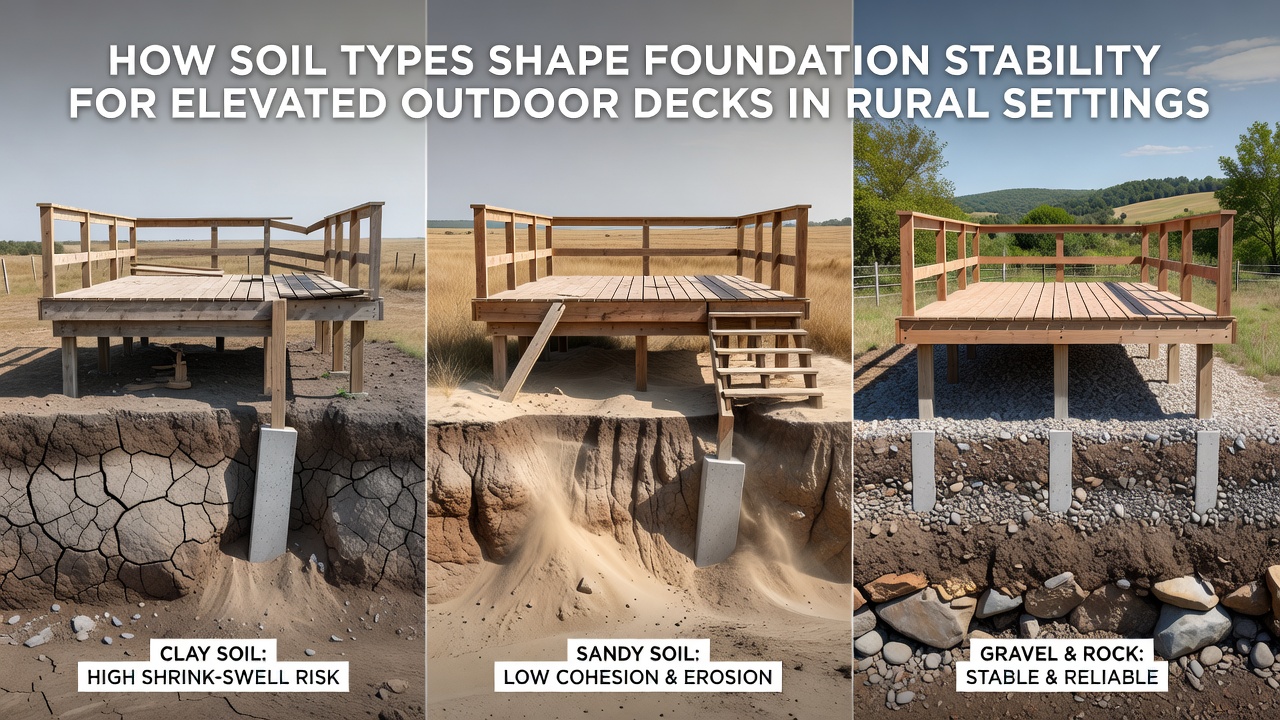
Soil types range from clay-heavy compositions that expand when wet to sandy mixes that drain rapidly yet offer lower cohesion. Clay soils, prevalent in many Midwest and Southern regions, absorb water and exert upward pressure on footings during wet periods then contract during dry spells. Sandy soils, common near river valleys and coastal rural zones, allow quick drainage but shift under load when particles rearrange. Loamy mixtures combine sand, silt, and clay particles and often provide moderate stability yet still require testing for organic content that can decompose and create voids. Silt-dominant soils appear in floodplains and retain moisture longer than sand while remaining less expansive than clay.
Effects of Soil Behavior on Elevated Deck Foundations
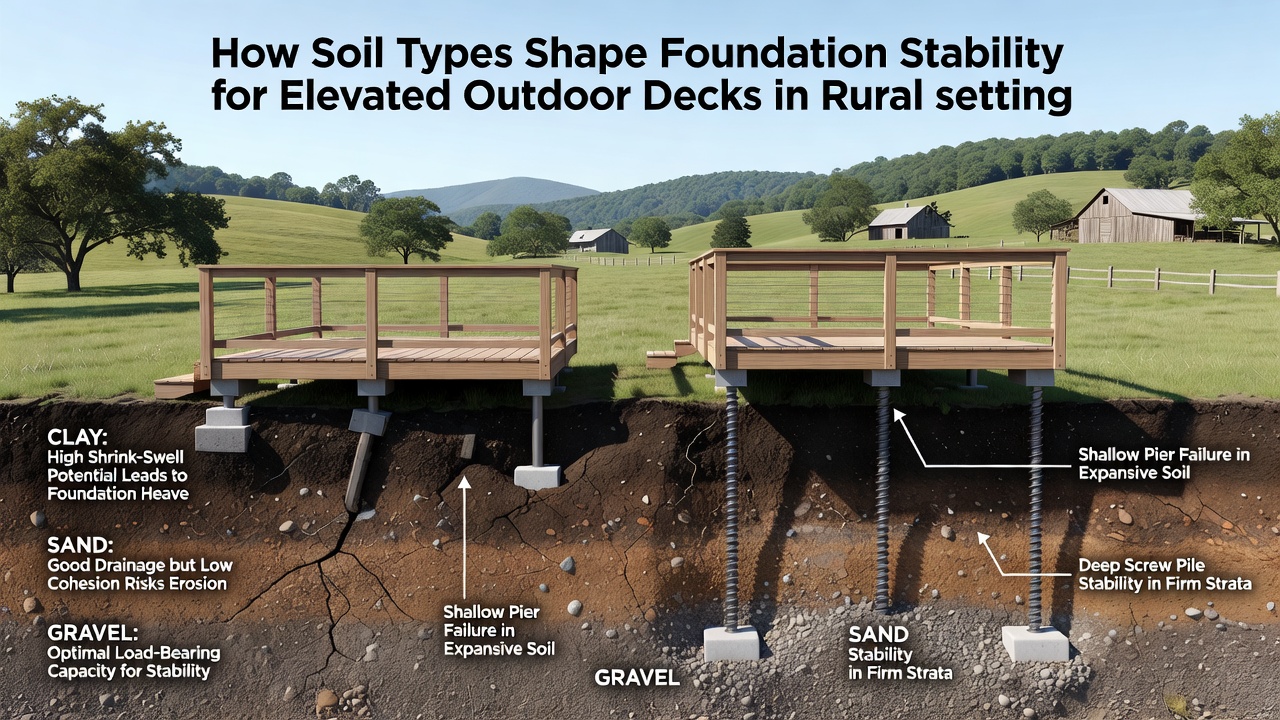
Elevated decks rely on vertical supports such as concrete piers, helical piles, or driven posts that transfer weight past unstable surface layers. In clay soils the piers must extend below the active zone where seasonal moisture changes cause volume shifts, otherwise differential movement cracks beams or loosens hardware. Sandy soils demand wider footings or deeper embedment to prevent lateral migration of particles under repeated loading from wind or foot traffic. Observers note that rural decks built on organic-rich soils experience gradual settlement as buried plant material breaks down and reduces support volume. Data from regional soil surveys indicate that bearing capacities can range from under 1,500 pounds per square foot in soft clays to over 4,000 pounds per square foot in dense gravelly loams, requiring adjustments in pier diameter and spacing.
Soil Testing Procedures Before Construction
Property assessments begin with visual inspection and hand auger sampling to identify layers at various depths. Professional engineers collect undisturbed samples and perform laboratory tests for Atterberg limits, Proctor density, and shear strength. In rural settings where municipal permits may not mandate reports, owners often hire independent technicians to map variations across the build site. Percolation tests reveal drainage rates that affect moisture accumulation around piers, while groundwater monitoring identifies seasonal high-water tables that could reduce effective soil strength. These steps establish the minimum embedment depth and reinforcement needs for each support location.
Adaptations in Foundation Design for Different Soils
Designers adjust pier depth, diameter, and reinforcement based on soil reports rather than using uniform specifications. In expansive clay areas, sleeves around piers reduce skin friction and allow vertical soil movement without lifting the deck structure. Helical piles gain popularity on sandy or loose soils because their torque readings during installation provide immediate verification of load capacity. Concrete grade beams connect individual piers on variable sites and distribute loads more evenly across inconsistent soil pockets. Gravel or crushed-stone backfill improves drainage around footings in silt-heavy soils, while geotextile fabrics prevent fine particles from migrating into drainage layers.
Regional Examples and Observed Outcomes
One documented project in the Pacific Northwest placed helical piers through a layer of compressible silt into underlying glacial till, achieving stable support for an elevated deck spanning a sloped rural lot. In contrast, a Midwest installation on clay without sufficient depth experienced seasonal heaving that required later retrofitting with additional anchors. Australian research published by the Commonwealth Scientific and Industrial Research Organisation highlights similar patterns on reactive clay sites where post-tensioned footings outperformed traditional piers when soil moisture fluctuated widely. Canadian provincial guidelines from Alberta Agriculture and Forestry recommend frost-susceptible soil identification in northern rural zones to set minimum embedment below the local frost line.
Long-Term Maintenance Considerations
Once installed, elevated decks on rural soils benefit from periodic inspection of soil conditions around supports. Erosion from heavy rain can expose shallow footings on sandy sites, while tree root growth in loamy areas may exert lateral pressure. Property owners monitor for new cracks in beams or changes in deck level that signal ongoing soil movement. Re-grading to direct water away from piers reduces moisture-induced volume changes in clay soils, and adding mulch or vegetation stabilizes surface soils against wind erosion in open rural settings.
Conclusion
Soil type determines the engineering approach required for stable elevated deck foundations in rural environments. Accurate classification, targeted testing, and tailored pier or pile designs address the specific movement and bearing characteristics of clay, sand, silt, and loam. Ongoing observation and site-specific adjustments help maintain structural integrity as environmental conditions evolve.